
Quick answer
To write a resignation letter, say in the first sentence that you are resigning, name your job title and your exact last day, thank your employer in one line, offer help with the handover, and sign off. In most U.S. jobs, two weeks of notice is a courtesy rather than a legal rule, because at-will employment lets either side end the job at any time.
Before you apply, get a free expert review of your resume within 48 hours. See exactly what is holding it back, with an ATS check and real rewrite examples. No credit card, no obligation.
Get my free resume reviewKey takeaways
- A resignation letter is a short, formal letter or email that tells your employer you are leaving and confirms your last working day.
- Every letter needs the same core parts: a resignation sentence, your job title, your last day, a thank-you, a handover offer and your name.
- Two weeks is the usual U.S. courtesy, not a law in most jobs. A contract, union agreement or public sector rules can set a different notice period.
- Tell your manager in person or on a video call first, then send the letter the same day and keep a dated copy.
- This page has a free Word template and 10 resignation letter examples by situation, from a short email to retirement.
A resignation letter is a short, formal note that tells your employer you are leaving your job and states your last working day. It gives HR and payroll a dated record, and it’s the last thing your manager reads from you before they become one of your references.
Below you’ll find the exact parts to include, a basic template you can download in Word, 10 letter of resignation examples you can copy, how to hand it in, and what to leave out. The U.S. facts on this page were checked on November 26, 2026.
What is a resignation letter?
A resignation letter is your formal written notice that you are ending your employment on a stated date. It is a record for your personnel file, not an announcement, an exit interview or a list of complaints.
The conversation with your manager does the real work. The letter confirms what you said, so there is no doubt later about your last day, your final pay period or whether you resigned or were let go. You’ll also hear it called a letter of resignation, a resignation notice or, when the notice is 14 days, a two weeks notice letter.
What should a resignation letter include?
A resignation letter should include seven parts: a header or subject line, a greeting, a clear resignation statement with your job title, your last working day, a short thank-you, a handover offer, and a closing with your name. Most letters fit all seven into four short paragraphs.
| Part | What it does | Example wording |
|---|---|---|
| 1. Header or subject line | Dates the letter and shows who it is from | Printed: your name, address and the date. Email subject: “Resignation: [Your Name]” |
| 2. Greeting | Addresses your direct manager | “Dear [Manager’s Name],” |
| 3. Resignation statement | Removes any doubt that you are leaving | “Please accept this letter as formal notice of my resignation from my position as [Job Title].” |
| 4. Last working day | Gives payroll and your manager a firm date | “My last day will be Friday, [date].” |
| 5. Thank-you | Keeps the tone warm and the reference intact | “Thank you for the chance to run the [project] rollout.” |
| 6. Handover offer | Shows you’ll leave your work in good order | “Before I leave, I will document my open accounts and brief [colleague].” |
| 7. Closing and name | Signs the letter and gives a way to reach you | “Sincerely, [Your Name]” plus a personal email if you want to stay in touch |
A reason for leaving is optional, so it isn’t on the list. If you give one, keep it to a single neutral line, such as “I have accepted a role closer to home.”
Basic resignation letter template (free Word download)
Here is a basic resignation letter template that works for most jobs. Copy the text, or download the same letter as a Word file, then replace every bracketed field with your own details.
[Your Full Name]
[Your Address]
[City, State ZIP]
[Email Address] | [Phone Number]
[Date]
[Manager Name]
[Manager Title]
[Company Name]
[Company Address]
Dear [Manager Name],
Please accept this letter as formal notice of my resignation from my position as [Your Job Title] at [Company Name]. My last day of work will be [Last Working Day], which provides [notice period, for example two weeks] of notice.
Thank you for the opportunity to be part of the team. I have genuinely valued [something specific you appreciated, for example the support of my colleagues and the chance to grow in this role], and I am grateful for the experience I have gained here.
To make the transition as smooth as possible, I am happy to help train a replacement, document my current projects, and complete any outstanding work before my last day. Please let me know how I can best support the handover.
I wish you and [Company Name] continued success, and I hope we can stay in touch.
Sincerely,
[Your Full Name]
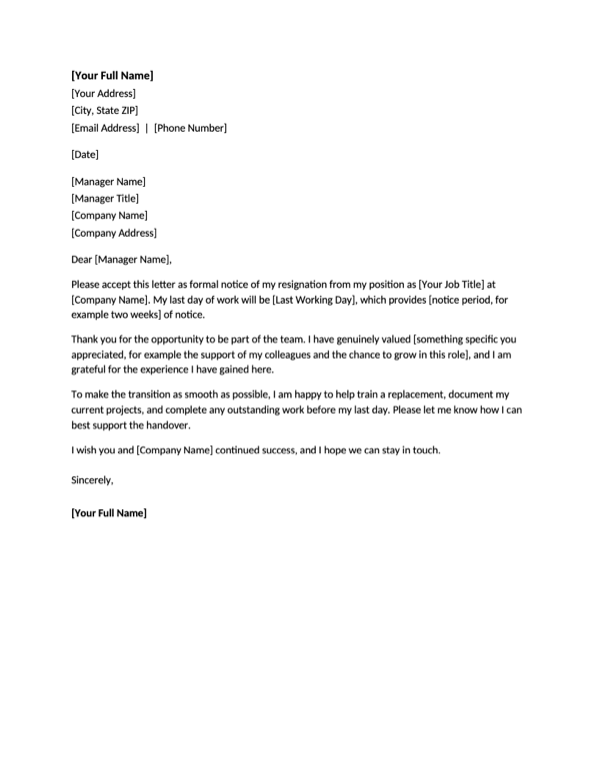
Download the resignation letter template
The letter above as an editable Word file. One page, US Letter size, plain single-column layout. Free, with no sign-up.
Rather fill in a form? Our free resignation letter generator asks for your name, job title, manager and last day, then writes the letter for you to copy or download. It runs in your browser, so nothing you type is uploaded.
How do you write a resignation letter?
To write a resignation letter, pick your last day, state your resignation in the first sentence, give the date, thank your employer, offer a handover and sign off.
Check your contract, then pick your last day
Read your offer letter, contract and handbook for a notice clause before you choose a date. If nothing sets one, two weeks is the usual courtesy, and a senior role often calls for more.
Do: “My last day will be Friday, [date].” · Not: “I will probably leave in a couple of weeks.”
Open with a clear statement of resignation
Say you are resigning in the first sentence and name your job title. Don’t hint, hedge or bury the news in the second paragraph.
Do: “I am resigning from my position as Account Manager.” · Not: “I have been thinking it might be time to move on.”
Thank your employer for something specific
One or two sentences are enough. Name something real, such as a project, a mentor or a skill you picked up.
Do: “Thank you for trusting me to lead the spring product launch.” · Not: “After everything I have put up with here.”
Offer a realistic handover
Name one or two things you will actually do before you go, such as finishing a report, writing handover notes or training a colleague. Promise only what fits in your notice period.
Do: “I will finish the quarterly report and document my client files.” · Not: “I will wrap up everything before I go.”
Sign off, proofread and keep a copy
Close with “Sincerely” or “Best regards” and your name. Check the date and the spelling of your manager’s name, send it, and save a dated copy outside your work account.
Do: “Sincerely, [Your Name]” · Not: three paragraphs of feedback about the company
10 resignation letter examples by situation
Find your situation in the table, then copy the matching example and replace the bracketed text. Every example names the role and a last day, and none of them explains more than it has to.
| Your situation | Use | The line that matters most |
|---|---|---|
| Most office jobs, printed or attached letter | Example 1: Standard | “My last day will be [date].” |
| You want the shortest polite version | Example 2: Short | “I am resigning, effective [date].” |
| You’re resigning by email after a conversation | Example 3: Email | “As we discussed this morning…” |
| You can’t work any notice | Example 4: Effective immediately | “…effective today, [date].” |
| You’ve accepted another offer | Example 5: New job | “I have accepted a new position.” |
| Health, family or another private reason | Example 6: Personal or health reasons | “For personal reasons, I need to step away.” |
| You’re leaving work for good | Example 7: Retirement | “I will retire from my position as [Job Title].” |
| Weekend, seasonal or student job | Example 8: Part-time | “My last scheduled shift will be [date].” |
| You want to give three weeks or more | Example 9: More than two weeks | “I can stay until [date].” |
| You’ve only been there weeks or months | Example 10: After a short time | “This role isn’t the right long-term fit for me.” |
Example 1: Standard resignation letter
[Your Name]
[Date]
Dear [Manager’s Name],
Please accept this letter as formal notice of my resignation from my position as [Job Title] at [Company Name]. My last day will be [date].
Thank you for your support over the past [number] years. I have learned a lot here, especially while working on [specific project].
Between now and my last day, I will finish [current task], write handover notes for my open work, and help train whoever takes over.
I wish you and the team every success.
Sincerely,
[Your Name]
This is the version to print and hand over, or attach as a PDF. It works for almost any salaried job.
Example 2: Short resignation letter
Dear [Manager’s Name],
I am resigning from my position as [Job Title], effective [date]. Thank you for the opportunity to work here. I will make sure my work is handed over before I leave.
Sincerely,
[Your Name]
Three sentences is enough. A short letter is not rude, and it’s the safest choice if the relationship with your manager is strained.
Example 3: Resignation email
Subject: Resignation: [Your Name], [Job Title]
Hi [Manager’s Name],
As we discussed this morning, I am resigning from my role as [Job Title]. My last day will be [date].
I have started a handover document for [project or accounts] and will share it with you by [day]. Please let me know if you would like me to brief anyone in particular.
Thank you for everything over the last [number] years.
Best regards,
[Your Name]
[Personal email]
Put “Resignation” and your name in the subject line so HR can find it later. Copy HR if your handbook asks you to, and save a copy to your personal email, because your work account will close.
Example 4: Resignation letter effective immediately
Dear [Manager’s Name],
Please accept this letter as notice of my resignation from my position as [Job Title] at [Company Name], effective today, [date].
I am sorry that I am unable to give the usual notice. I have saved notes on the status of my open work in [location], and I will return my [laptop, badge, keys] by [date].
Please send any paperwork about my final pay and benefits to [personal email or home address].
Sincerely,
[Your Name]
Keep this one factual and brief, even if you’re leaving because something went wrong. If you are leaving over safety, harassment or unpaid wages, keep your own records and get advice before you resign, because your reasons may matter later.
Example 5: Resignation letter for a new job
Dear [Manager’s Name],
I am writing to let you know that I have accepted a new position and am resigning from my role as [Job Title]. My last day at [Company Name] will be [date].
Working with you on [project or skill] taught me more than I expected, and I’m grateful for it.
Over my remaining time, I will hand [client or task] to [colleague] and keep a running list of anything still open.
I’d like to stay in touch. You can reach me at [personal email] after I leave.
Best regards,
[Your Name]
You don’t have to name the new employer or the pay. Wait until you have the new offer in writing before you send this, and read any non-compete or confidentiality clause first.
Example 6: Resignation letter for personal or health reasons
Dear [Manager’s Name],
For personal reasons, I need to step away from my position as [Job Title]. Please accept this letter as my resignation, with my last day on [date].
I’d prefer to keep the details private, and I appreciate your understanding. My decision has nothing to do with the team.
Before I go, I will finish [most urgent task] and leave clear notes on everything else.
Thank you for your support during my time here.
Sincerely,
[Your Name]
“Personal reasons” is a complete answer, and you don’t need to name a diagnosis or a family situation. If the reason is your own health or a relative’s care, ask HR about leave first. Under the Family and Medical Leave Act (FMLA), eligible employees can take up to 12 workweeks of unpaid, job-protected leave in a 12-month period, so quitting may not be your only option.
Example 7: Retirement resignation letter
Dear [Manager’s Name],
After [number] years with [Company Name], I am writing to let you know that I will retire from my position as [Job Title]. My last day of work will be [date].
It has been a privilege to work here. I’m especially proud of [achievement or project], and I’m grateful to have worked alongside such a capable team.
To help with the transition, I’m happy to document my processes, introduce my successor to [key contacts], and stay until [later date] if that would help.
Please let me know what I need to complete with HR about my retirement benefits.
With thanks,
[Your Name]
Retirement letters often give more notice than two weeks, sometimes months, because passing on years of knowledge takes time. Talk to HR before you set the date, as pension and health plan rules can depend on it.
Example 8: Resignation letter for a part-time job
Hi [Supervisor’s Name],
Please accept this as my resignation from my part-time position as [Job Title] at [Store or Location]. My last scheduled shift will be [day and date].
I will work every shift I’m on the schedule for until then. I can also help train a new team member on [task] if that’s useful.
Thank you for working around my [class or other job] schedule. I really appreciated the flexibility.
[Your Name]
[Phone]
In shift work, name your last shift, not only a date. Check the posted schedule first, and ask how to return your uniform, badge or keys.
Example 9: Resignation letter giving more than two weeks notice
Dear [Manager’s Name],
I am resigning from my position as [Job Title]. Because [the year-end close, my client portfolio, hiring for this role] will take time to hand over, I can stay until [date], which is [five] weeks from today.
During that time I will [finish project], write up [process], and help interview or train my replacement.
If an earlier last day works better for the team, I’m happy to talk it through.
Sincerely,
[Your Name]
Long notice is generous, but in an at-will job your employer can accept your resignation and end things sooner. Offer extra weeks only if you could cope with an earlier last day. If you teach, check your contract for a resignation deadline. In the UK, teachers in maintained schools in England and Wales resign to fixed dates, listed in our guide to teacher resignation dates.
Example 10: Resignation letter after a short time
Dear [Manager’s Name],
I am resigning from my position as [Job Title], with my last day on [date].
I didn’t make this decision lightly. After [number] months, I’ve realized this role isn’t the right long-term fit for me, and I think it’s fairer to say so now.
Thank you for the time you and the team spent training me. Before I leave, I’ll write up where each of my tasks stands so nothing gets lost.
Sincerely,
[Your Name]
One honest sentence is plenty after a short stint. Don’t apologize at length or list what went wrong, because the letter stays in your file.
Leaving for something better? Make sure your resume is ready
Upload your resume and one of our writers will send you a free, honest review within 48 hours, with the changes that would make the biggest difference.
Is a resignation letter required by law in the U.S.?
No. In most U.S. jobs, neither a resignation letter nor a set notice period is required by law. According to USA.gov, the federal government’s official information site, all states except Montana allow at-will employment, which means an employer or an employee can end the job at any time, for any reason that isn’t illegal.
The same page notes that at-will rules don’t cover people working under a signed contract, under a union’s collective bargaining agreement (the contract between a union and an employer), or in the public sector. If one of those applies to you, its notice terms come first. The letter still matters in practice, because it’s the record of when and how you left.
| Check | Why it matters | Official source |
|---|---|---|
| Contract, offer letter or union agreement | May set a notice period you have to follow | USA.gov, at-will exceptions |
| Final paycheck date | Federal law doesn’t require immediate final pay, but some states do | DOL, Last Paycheck |
| Health coverage | COBRA can let you keep your group health plan for a limited time after a voluntary job loss. It generally applies at employers with 20 or more employees | DOL, COBRA |
| Unemployment benefits | States usually pay benefits to people unemployed through no fault of their own, so quitting can affect eligibility | DOL, Unemployment Insurance |
| Leave options | FMLA leave may be an alternative to resigning for a serious health condition | DOL, FMLA |
On final pay, the Department of Labor says employers aren’t required by federal law to pay former employees immediately, though some states require it. Health coverage is covered by COBRA, which lists voluntary job loss as a qualifying event. For unemployment insurance, each state sets its own rules, and you usually qualify if you are unemployed through no fault of your own, which in most states means you left because there was no work available.
How many people resign each month?
Around 3 million to 3.4 million Americans quit their jobs every month. Over the 12 months to September 2026, the monthly figure stayed between 2.98 million and 3.37 million, according to the Bureau of Labor Statistics.
U.S. quits per month, October 2025 to September 2026
Millions of workers who left their jobs voluntarily, seasonally adjusted. September 2026 (yellow) is preliminary.
Source: U.S. Bureau of Labor Statistics, Job Openings and Labor Turnover Survey, series JTS000000000000000QUL (quits, total nonfarm, seasonally adjusted), retrieved November 26, 2026.
Resigning is ordinary. Managers handle these letters all the time, so a calm, standard letter is exactly what they expect to receive.
How should you hand in your resignation letter?
Tell your manager in person or on a video call first, then send the letter the same day. The letter should confirm a conversation, not replace it.
A few practical points make the handover easier:
- Timing: ask for ten minutes early in the week, not late on a Friday or just before a deadline.
- Email or paper: either is fine. Email gives you a time-stamped record, and a PDF attachment with your typed name looks more formal than text in the body.
- Who gets it: address it to your direct manager and copy HR if your handbook says to.
- Remote jobs: resign on a video call with cameras on, then email the letter straight after.
- Telling coworkers: let your manager decide how the team hears, and don’t post about it online until they have.
“Write your resignation letter for the person who opens your file in three years to check a reference. Short, dated and polite always reads well later. A paragraph written in frustration never does.”
ResumeCroc resume team
What should you not put in a resignation letter?
Leave out complaints, blame, details about your new job or salary, and anything you wouldn’t want a future employer to read. If you have honest feedback, save it for the exit interview, and keep it constructive there too.
| Write this | Not this |
|---|---|
| “I am resigning from my position as [Job Title].” | “I feel like I may need to start thinking about leaving.” |
| “My last day will be Friday, [date].” | “I’ll be gone in a couple of weeks or so.” |
| “I have accepted a new position.” | “I’m leaving for a company that actually pays fairly.” |
| “For personal reasons, I need to step away.” | Details of a diagnosis, a divorce or a family crisis |
| “I will document my open projects.” | “I’ll get everything done before I go.” |
| “Thank you for the chance to lead [project].” | Criticism of your manager, a colleague or the company |
Also skip counteroffer hints such as “unless something changes.” If you might stay for more money, have that conversation before you write anything down.
Resignation letter checklist
Run through this list before you press send or hand the letter over.
- The first sentence says you are resigning and names your job title.
- Your last working day is an exact date (or, for shift work, your last shift).
- The notice period matches your contract, handbook or union agreement.
- There’s one specific, sincere line of thanks.
- The handover offer names things you will actually do.
- No complaints, blame, salary details or private health information.
- Your manager’s name is spelled correctly and the date is today’s.
- The email subject line says “Resignation” and your name.
- You told your manager in person or by video before sending it.
- You saved a dated copy outside your work account.
What should you do after you resign?
After you resign, finish your handover well and get your next move ready. Note your recent achievements with real numbers while you still remember them, collect personal contact details for the people you’d like as references, and never take confidential company files.
If you don’t have an offer yet, your resume matters more than your letter. Our professional resume writing service starts with the Starter Pack at $149, delivers a first draft in 3 to 5 business days, and every resume package comes with a 45-day interview guarantee: if you get no interview invitations within 45 days of your final resume, we rewrite it once, free of charge. Hiring also moves with the calendar, so check the best time to look for a job as you plan.
A few more guides help at this stage. Practice answering “why are you leaving your job?” in interviews, put together a reference page for your resume, and if you’re weighing two offers, accept one in writing first and then decline the other offer politely.
Is your resume ready for the next role?
Paste your resume and a job description into our free checker for an instant ATS score, the keywords you’re missing and a list of fixes. It all runs in your browser, so nothing is uploaded.
Frequently asked questions
How do I write a simple resignation letter?
Write three sentences: say you are resigning from your job title, give your last day, and thank your employer. For example: “I am resigning from my position as [Job Title], effective [date]. Thank you for the opportunity to work here. I will hand over my work before I leave.” Add your name and send it.
How much notice should I give when I resign?
Two weeks is the usual notice in the U.S., but in most jobs it’s a courtesy, not a legal rule. Check your contract, handbook or union agreement first, because any of them can set a longer period. Senior and specialist roles often give three or four weeks so the handover isn’t rushed.
Do I have to give a reason in my resignation letter?
No. A reason is optional, and many good resignation letters don’t give one. If you want to explain, use one neutral line such as “I have accepted a new position” or “for personal reasons.” Keep detailed feedback for the exit interview, and leave complaints out of the letter entirely.
Can I email my resignation letter?
Yes. Email is a normal way to resign, and it gives you a dated record. Tell your manager in person or on a video call first, then send the email the same day with “Resignation” and your name in the subject line. Copy HR if your handbook asks, and keep a copy in your personal email.
Can I resign effective immediately?
In most at-will U.S. jobs you can, but it may cost you goodwill, a reference or your chance of being rehired. Check your contract first, because a notice clause could apply. If you must leave the same day, keep the letter short and factual, apologize once for the short notice and say where your handover notes are.
Who should I address my resignation letter to?
Address it to your direct manager, by name. If your company’s handbook says resignations go to HR as well, copy HR on the email or give them a second copy. Don’t send it to the whole team: your manager should decide how and when your coworkers hear the news.
What should you not say in a resignation letter?
Don’t include complaints, blame, gossip, your new salary, threats or hints that you might stay for a counteroffer. Leave out private health or family details too. The letter goes into your personnel file and can be read years later, so write only what you’d be comfortable with a future employer seeing.
Get a free expert review before your next application
Our writers will read your current resume and send back a free, no-obligation review within 48 hours. Prefer to hand it over? See our resume writing packages.
Sources
- U.S. Department of Labor, Last Paycheck (checked November 26, 2026)
- USA.gov, Termination guidance for employers (at-will employment in all states except Montana, and its exceptions; page last updated March 24, 2025, checked November 26, 2026)
- U.S. Department of Labor, Wage and Hour Division, Family and Medical Leave Act (checked November 26, 2026)
- U.S. Bureau of Labor Statistics (BLS), Job Openings and Labor Turnover, September 2026 (released November 3, 2026), and series JTS000000000000000QUL, quits, total nonfarm, seasonally adjusted (retrieved November 26, 2026)
- U.S. Department of Labor, Continuation of Health Coverage (COBRA) (checked November 26, 2026)
- U.S. Department of Labor, Unemployment Insurance (checked November 26, 2026)

 By uploading my resume, I agree to the