How to Explain Redundancy on Your CV (UK Examples)
Wording you can copy for your CV, cover letter and interview, with lines for five sectors and a free A4 Word template. Written by working CV writers for UK job seekers.
Free Word template, no sign-up · Official sources checked 24 November 2026

Quick answer
To explain redundancy on your CV, add one factual line at the end of that job, such as “Role made redundant following a company restructure, March 2026”. Name the business reason, give the month and year, then go back to your results. The National Careers Service gives the same advice: describe the business decision, not yourself.
Redundancy is a type of dismissal that happens when an employer no longer needs a role. That is how both Acas (the Advisory, Conciliation and Arbitration Service) and gov.uk describe it. The job went. You didn’t fail at it, and your CV should say so in about a dozen words.
This page covers the wording: what to write, where it goes, and what to say when someone asks. We are CV writers, not employment advisers, so for pay, notice and your rights we point you to the official sources further down.
Key takeaways
- You don’t have to mention redundancy on a CV, but one short line usually helps when it was your most recent job or it left a gap.
- Write “Role made redundant”, not “I was made redundant”. Add the business reason and the month and year, for example “following closure of the Derby site, June 2026”.
- Put the line last under that job, in plain text. Every bullet above it should be a result.
- If you have been out of work for about three months or more, add a dated entry for what you did with the time: courses, contract work, volunteering or caring.
- Use the same reason on your CV, in your cover letter and at interview. It should match your redundancy letter and your reference.
- About 120,000 people in the UK reported a redundancy in July to September 2026, according to the Office for National Statistics. Recruiters see it every week.
Do you put redundancy on a CV?
You don’t have to, but one line usually helps. No rule says a CV must give a reason for leaving a job, and many people leave the reason off every role. The case for adding it is practical. A job that ended recently with nothing after it makes a recruiter wonder, and a short factual line settles it before the question comes up.
Add the line when the redundancy was your most recent job, when you have been out of work for a month or more, or when the job was short and could read as a bad hire. It also helps when the whole site, team or company closed, because that makes it obvious the decision wasn’t about you.
Leave it off when the redundancy was two or more jobs ago, or when you moved straight into another role with no break. If you are still working your notice, you are still employed, so the dates stay as “to present” and no redundancy line is needed yet.
How do you word redundancy on a CV?
Use one line with three parts: what happened to the role, the business reason, and the month and year. Make the role the subject of the sentence. “Role made redundant following a company restructure, March 2026” is complete, and it takes up one line of an A4 page.
The National Careers Service, the government careers service for England, advises the same approach: outline the business decision rather than anything about you as a person. Here is how to build the line.
Take the reason from your redundancy letter
Your letter names the reason: a restructure, a closure, a relocation, less work coming in. Use the same reason, so your CV, your reference and your interview answer all agree.
Example: The letter says “closure of the Swindon distribution centre”. The CV says “Role made redundant following closure of the Swindon distribution centre, May 2026.”
Make the role the subject
Start with “Role”, “Post” or “Position”. It keeps the line about the job and removes the apology that creeps in when the sentence starts with “I”.
Before: “Unfortunately I was let go due to cutbacks.” After: “Role made redundant following a company restructure, March 2026.”
Add the scale if it helps you
If a whole team, shift or site went, say how many roles. A number shows the decision was about the business.
Example: “Site closed in June 2026 with all 85 roles made redundant.”
Give the month and year
Use the month you left, matching the end date beside the job title. Month and year is the normal level of detail on a UK CV.
Example: “Warehouse Team Leader, [Employer], Swindon. April 2019 to May 2026.”
Put it last, then stop
Make it the final bullet under that job, in the same plain text as the rest. Don’t put it in bold, and don’t add a second sentence explaining how you felt about it.
Example: Three or four result bullets first, then “Role made redundant following a company restructure, March 2026.”
| Situation | CV wording | Where it goes |
|---|---|---|
| Company or department restructure | “Role made redundant following a company restructure, March 2026.” | Last bullet under that job |
| Site, branch or office closed | “Left when the Derby site closed, with all 85 roles made redundant, June 2026.” | Last bullet under that job |
| Employer went into administration | “Company entered administration and ceased trading, January 2026.” | Last bullet, or in brackets after the employer name |
| Team moved to another town | “Role relocated to Glasgow; left through redundancy, October 2026.” | Last bullet under that job |
| Voluntary redundancy | “Took voluntary redundancy during a company-wide restructure, September 2026.” | Last bullet under that job |
| Short job (under a year) ended by redundancy | “March 2026 to October 2026 (role made redundant: site closure)” | Beside the dates, so nobody reads it as job hopping |
| Still working your notice | No redundancy line yet. Dates stay “to present”. Add “Available from February 2027”. | Personal profile |
| Out of work for three months or more | “Professional development, July 2026 to present”, with courses or contract work listed under it | Its own dated entry above the last job |
| Redundancy was two or more jobs ago | Nothing. The dates are enough. | Nowhere |
If you left under a settlement agreement, read it before you write anything. Acas explains that these agreements can include an agreed reference and a confidentiality clause, so check that your wording fits what you signed. Ask Acas or your adviser if you are unsure.
Redundancy CV examples for 5 UK sectors
The reason for a redundancy sounds different in a shop, a hospital trust and a software company. Below are lines you can copy for five sectors. Swap the square brackets for your own details and keep whichever line matches your redundancy letter.
Retail
Retail redundancies are usually store closures, administrations or management layers being merged. Name the store or region so the reader can place it.
- “Role made redundant when the [town] store closed, [Month Year].”
- “Store closed as part of a national closure programme, with all [number] roles made redundant, [Month Year].”
- “Position removed in a regional restructure that merged [number] store manager roles into [number], [Month Year].”
- “[Retailer] entered administration and ceased trading, [Month Year].”
Pair it with a result from the final months, such as “Kept the store in the top [number] of [number] in the region for conversion while running the closing sale and stock transfer.” For a full layout, see our retail assistant CV examples.
NHS and public sector
Public sector employers say “post” where a company says “role”, and they call a restructure “organisational change”. Use the words in your letter. Many public sector application forms also have a “reason for leaving” box, where “Redundancy (restructure)” is enough.
- “Post made redundant following a restructure of the [directorate or team], [Month Year].”
- “Left through the organisation’s voluntary redundancy scheme during a [council or department] restructure, [Month Year].”
- “Post removed when [two teams or organisations] merged and duplicate posts were reduced, [Month Year].”
- “Left when the [service or programme] closed and its posts were made redundant, [Month Year].”
If you were on a fixed-term contract that reached its end date, you can write “Fixed-term contract ended, [Month Year]”, which reads just as cleanly. Whether the end of a fixed-term contract counts as redundancy depends on your situation, so check gov.uk or Acas, and use the wording in your letter.
Staying in health? Our NHS CV writing service covers supporting statements too.
Tech
Tech redundancies tend to come as company-wide cuts, cancelled products or funding that fell through. Hiring managers in the sector know this, so one plain line is plenty.
- “Role made redundant in a company-wide reduction of around [number]% of staff, [Month Year].”
- “Team disbanded when the roadmap was cancelled, [Month Year].”
- “Company closed after its funding round did not complete, with all staff made redundant, [Month Year].”
- “Engineering moved to the [city] hub and UK roles were made redundant, [Month Year].”
Pair it with what you shipped: “Released [feature] to [number] users [number] weeks before the team closed, and handed over documented runbooks to the remaining engineers.” Our software developer CV examples show the rest of the page.
Finance
In banking, insurance and accountancy, the usual causes are mergers, branch closures and work moving to a shared service centre. Say which one, because “restructure” alone tells a finance recruiter very little.
- “Role made redundant following the merger with [firm] and consolidation of the two [finance or operations] teams, [Month Year].”
- “Branch closed under the [bank] branch closure programme, [Month Year].”
- “Function moved to the [city or offshore] shared service centre and UK roles were made redundant, [Month Year].”
- “Desk closed when the firm withdrew from , [Month Year].”

Pair it with proof that you stayed professional to the end: “Completed month-end close for [number] entities during the handover, with no audit points raised.” See our accountant CV examples for layout.
Manufacturing
Manufacturing redundancies are often the easiest to explain, because a closed plant or a lost contract is a matter of public record. State it and add the numbers.
- “Site closed and production moved to [location], [Month Year].”
- “Role made redundant when the plant moved from three shifts to two, [Month Year].”
- “[Line or cell] decommissioned after the [customer] contract ended, with [number] roles made redundant, [Month Year].”
- “Company entered administration and the site stopped production, [Month Year].”
Pair it with a production figure: “Held line [number] at [number]% OEE (overall equipment effectiveness) through the final [number] months of production.” Moving into logistics? Start from our warehouse operative CV examples.
“The redundancy line is the least interesting sentence on your CV, and that’s how it should be. Give it twelve words and a date. Spend the rest of the page on what you did while the job existed.”
ResumeCroc CV teamPersonal profile examples after redundancy
Your personal profile is the three or four lines under your name that say who you are and what you want next. In most cases it shouldn’t mention redundancy at all, because the profile is there to sell and the reason for leaving sits further down. These four examples use sample details. Replace them with your own.
- No mention (the default): “Operations manager with 12 years in food manufacturing, most recently running a 140-person site with a £9m annual budget. Cut changeover time by 22% and went three years without a lost-time accident. Looking for a plant or operations manager role in the East Midlands.”
- Available now: “Accounts payable analyst with eight years in a financial services shared service centre. Processed 4,000 invoices a month at 99.6% accuracy and trained six colleagues on a new purchase-to-pay system. Available immediately following a company restructure and looking for an AP team leader role in Leeds.”
- Changing career: “Retail store manager with 15 years leading teams of up to 40, now moving into HR. Ran recruitment, rotas, absence and disciplinary meetings for a £4m store, and completed the CIPD Level 3 Foundation Certificate in People Practice in 2026. Looking for an HR assistant or HR adviser role.”
- Long service with one employer: “Production planner with 21 years at one automotive supplier, promoted four times from line operator. Planned output for three lines and 180 staff, and kept on-time delivery above 97% for five years running. Looking for a senior planning role in the West Midlands.”
The second example is the only one that mentions the restructure, and it does so in five words. Use that version when you want agencies to know you can start straight away. If redundancy has pushed you towards a new field, our career change CV writing service is built for that move.
Not sure how your CV reads now?
Send it to us for a free review. A CV writer will tell you what is working, what is missing and how the redundancy line reads, within 48 hours.
Get my free CV reviewWhat does a good CV after redundancy look like?
It looks like any strong UK CV: two pages of A4, a personal profile, key skills, employment history with the newest job first, then education. The redundancy takes up one line of it. Nothing else about the layout needs to change.
Leave off your age, date of birth, marital status and nationality: the National Careers Service CV guidance says not to include them, and suggests “references are available on request” in place of referees’ contact details. UK CVs don’t carry a photo either.
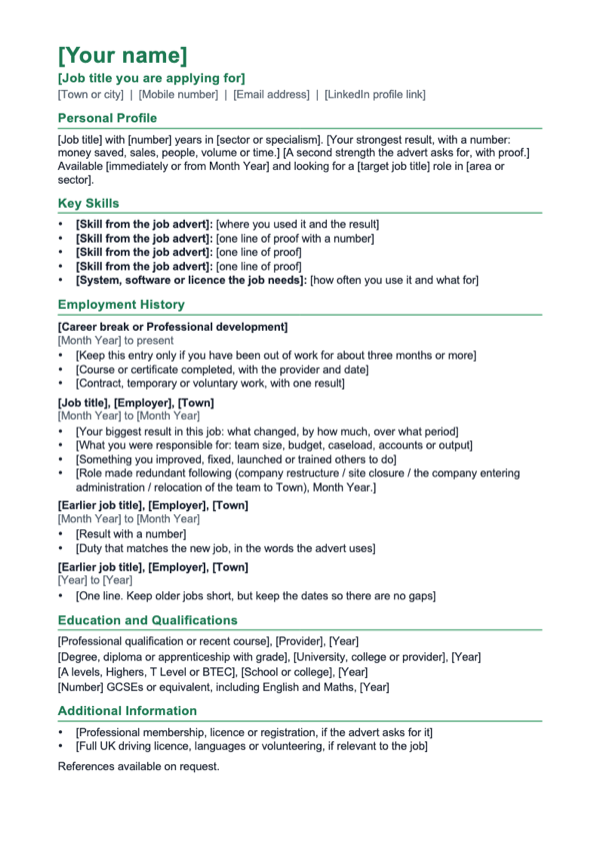
The free template below follows this order and has the redundancy line already in place. For worked CVs by job title, browse our UK CV examples.
Free download
Free redundancy CV template (UK, Word, A4)
This is an editable Word file set up for A4. Replace the text in square brackets, delete what you don’t need and save it as Word or PDF. There is no sign-up and no email form.
- Personal Profile, Key Skills, Employment History, Education and Qualifications
- A fill-in redundancy line as the last bullet of your most recent job
- An optional “Professional development” entry for time since you left
- One column, no tables or text boxes, so recruitment software can read it
- No photo, date of birth or marital status, and Arial at size 11
How do you show time since redundancy on your CV?
For the first few weeks, you don’t need to show anything. Give the real end date and the redundancy line, and carry on applying. Once the break reaches about three months, add a dated entry that says what you have been doing, so the top of your employment history isn’t an empty stretch.
That entry can be study, contract or temporary work, volunteering, or caring for someone. It doesn’t have to be impressive. It has to be true, dated and relevant where possible. The National Careers Service says a gap on a CV is not a problem, but that you may be asked about it.
| Time since you left | What to add | Example line |
|---|---|---|
| Still in your notice period | Nothing yet. Add your availability to the profile. | “Available from February 2027.” |
| Under three months | The real end date and the redundancy line. No extra entry. | “Role made redundant following a company restructure, October 2026.” |
| Three to six months | A short dated entry for courses, contract work or volunteering | “Professional development, August 2026 to present: completed IOSH Managing Safely and a four-week contract covering stock audits.” |
| More than six months | A dated entry that names the main thing you did, with one result if you have one | “Career break, March 2026 to present: full-time carer for a family member, plus Saturday volunteering at a community food bank managing a rota of 12.” |
Put the entry at the top of your employment history, above the job that was made redundant, because a UK CV runs newest first. Give it two or three bullets at most. If you took a course, name the provider and the date you finished.
What do you say about redundancy in a cover letter?
Say it once, in one or two sentences, then move to what you offer. A cover letter has more room than a CV, so it can carry the business reason and link it to why you are applying. Put the paragraph second, after your opening line about the job. Copy this and fill in the brackets.
If the redundancy was a while ago and you have worked since, leave it out of the letter completely. If you are changing sector because of it, add one sentence on why the new field suits you and what you have done to prepare.
How do you explain redundancy in an interview?
Give a 30-second answer in three parts: what happened to the role, what you achieved there, and why you want this job. Keep to the facts on your CV. Don’t criticise your old employer, even if the process was badly handled, because the interviewer is picturing how you would talk about them.
Expect one or two follow-up questions. Have a plain, short answer ready for each.
- “Why was your role chosen?” Answer with a fact about the business: “The whole site closed”, or “The company cut 30 roles across operations and mine was one of them.”
- “What have you been doing since?” Name two or three things with dates: a course, contract work, volunteering, and how many applications or interviews you have had if the number is healthy.
- “Would you have stayed?” “Yes, I enjoyed the work” is a fine answer. Then say what you want from the next job.
How common is redundancy in the UK?
It is common enough that most recruiters deal with it every week. In July to September 2026, about 120,000 people in the UK reported that they had been made redundant in the three months before their survey interview. That works out at 4.0 redundancies per 1,000 employees, according to the Office for National Statistics (ONS) figures released on 17 November 2026.
The figure moves around. Since the start of 2022 the calendar-quarter figure has ranged from 55,000 (April to June 2022) to 145,000 (October to December 2025). Across every three-month period ONS has published since 1995, the highest is 398,000, in September to November 2020, when the rate reached 14.3 per 1,000 employees.
People made redundant in the UK, by quarter
Source: ONS Labour Force Survey, seasonally adjusted. People who reported being made redundant, or taking voluntary redundancy, in the three months before interview.
Source: Office for National Statistics, Labour market statistics time series, “LFS: ILO redundancy level (thousands): UK: All: SA” (series BEAO), released 17 November 2026, retrieved 24 November 2026. Bars are scaled to the highest quarter shown.
These are survey estimates, and the ONS advises caution about reading too much into short-term changes in Labour Force Survey figures. The broad picture is steady, though. In every quarter shown above, between 106,000 and 145,000 people went through what you are going through.
Where can you get help with redundancy rights and pay?
Use the official sources, because the answers depend on your contract, your length of service and where in the UK you work. We don’t give advice on pay, notice or whether a redundancy was fair.
- Your rights, notice and redundancy pay: Redundancy: your rights on gov.uk.
- Free, impartial advice: Acas guidance on your rights during redundancy, or the Acas helpline on 0300 123 1100.
- Northern Ireland: nidirect, which points to the Labour Relations Agency for advice.
- Help finding work: gov.uk lists help finding a new job, including the Jobcentre Plus Rapid Response Service in England and the separate services in Scotland and Wales.
In the US? The wording and conventions are different there. Read our guide on how to explain a layoff on your resume.
Redundancy CV checklist
Run through this before you send the CV anywhere.
- The end date of the redundant job is the real month and year you left
- The redundancy line is one sentence, starts with “Role” or “Post”, and names the business reason
- The reason matches your redundancy letter and what your referee will say
- Every other bullet under that job is a result, with a number where you have one
- A break of three months or more has its own dated entry
- The personal profile says what you want next, and mentions the redundancy only if you want to flag that you can start now
- Two pages of A4, one column, no photo, date of birth or marital status
- The cover letter and your interview answer give the same reason in the same words
Want a second opinion from software first? Paste the CV and the job advert into our free UK CV checker. It runs in your browser and lists the keywords you are missing, along with US spellings and personal details to take out.
Want a CV writer to do it for you?
Our UK CV packages start at £129 for an expert-written CV matched to your target role. Career Growth at £169 adds a cover letter written for the job, and Executive Priority at £299 adds a LinkedIn profile rewrite. Start with a free review if you’d like our view first.
See UK CV writing packagesFrequently asked questions
Do you put redundancy on a CV?
You don’t have to, but one short line usually helps. Add it when the redundancy was your most recent job, when it left a gap of a month or more, or when the job was short. Leave it off when it happened two or more jobs ago, or when you went straight into another role.
What is the best way to word redundancy on a CV?
Use one line with the role as the subject, the business reason and the date: “Role made redundant following a company restructure, March 2026”. Put it as the last bullet under that job, in plain text. Take the reason from your redundancy letter so that your CV, your reference and your interview answer all match.
Does redundancy look bad on a CV?
No. Redundancy happens when an employer no longer needs a role, so it says nothing about how well you did the job. About 120,000 people in the UK reported a redundancy in July to September 2026, according to the Office for National Statistics. What reads badly is a vague or missing explanation, so state it plainly and move on.
How do you explain redundancy in an interview?
Give a 30-second answer in three parts: what happened to the role, what you achieved there, and why you want this job. For example: “My role was made redundant in March when the site closed. I’m proud that we cut scrap by 18% in my last year, and this job fits because you run the same kind of line.”
How do you explain a gap after redundancy on your CV?
Add a dated entry at the top of your employment history once the gap reaches about three months. Call it “Professional development” or “Career break”, give the start month and “to present”, and list what you did: courses, contract or temporary work, volunteering or caring. Two or three bullets is enough.
Should I mention voluntary redundancy on my CV?
Yes, if the redundancy is recent, and you can choose whether to include the word “voluntary”. Acas describes voluntary redundancy as putting yourself forward before being selected. “Took voluntary redundancy during a company-wide restructure, September 2026” shows that leaving was your decision, which some people prefer. “Role made redundant” is also accurate.
Should I mention redundancy in my cover letter?
Yes, if it was your most recent job, and keep it to one or two sentences. Say when the role was made redundant and why, give one result from your time there, then explain why you want this job. If you have worked somewhere else since the redundancy, leave it out of the letter.
What end date do I put on my CV if I am still working my notice?
Keep “to present” until your leaving date, because you are still employed while you work your notice. Add “Available from” and the month to your personal profile so recruiters know when you can start. Once the leaving date has passed, change it to the real month and year and add the redundancy line.
Sources
- GOV.UK, Redundancy: your rights, Get help finding a new job and Fixed-term employment contracts: renewing or ending a fixed-term contract, checked 24 November 2026.
- Acas, Redundancy, Volunteering for redundancy and Settlement agreements, checked 24 November 2026.
- Office for National Statistics, LFS: ILO redundancy level (BEAO) and LFS: ILO redundancy rate (BEIR), Labour market statistics time series, released 17 November 2026, retrieved 24 November 2026.
- Office for National Statistics, A guide to labour market statistics (definition of redundancy levels and rates), checked 24 November 2026.
- National Careers Service, Explain a gap in your employment and How to write a CV, checked 24 November 2026.
- nidirect, Your rights if made redundant (Northern Ireland), checked 24 November 2026.

 By uploading my CV, I agree to the