Before you apply, get a free expert review of your resume within 48 hours. See exactly what is holding it back, with an ATS check and real rewrite examples. No credit card, no obligation.
Get my free resume reviewKey takeaways
- A fast food crew member, advertised as a “team member” at Chick-fil-A and Taco Bell and a “crew member” at McDonald’s, runs the front counter, drive-thru, and food-prep line, and is judged on speed, order accuracy, and food safety, not just “taking orders”.
- The crew members who get hired and promoted prove measurable impact: drive-thru service times, order accuracy, upsell rate, guest-satisfaction scores, and a clean health inspection.
- Most applications are screened by software first, mirror the job-posting keywords and keep the format simple to get past it.
- Run your resume through our free ATS resume checker before you apply.
A fast food crew member job description covers far more than flipping burgers, the same role is posted as a “team member” at Chick-fil-A and Taco Bell, a “crew member” at McDonald’s, and simply “crew” almost everywhere else, and it sits at the centre of a fast-paced operation where speed, accuracy, and hospitality are measured on every single order. Whether you are a manager writing the posting or an applicant trying to turn shifts on the line into a resume that gets interviews, this guide breaks down exactly what a fast food crew member does, front counter, drive-thru, and food-prep line, the duties and responsibilities employers expect, the skills that matter most, what the role pays, and how to present all of it on a resume that beats the applicant tracking system (ATS).
What does a fast food crew member do?
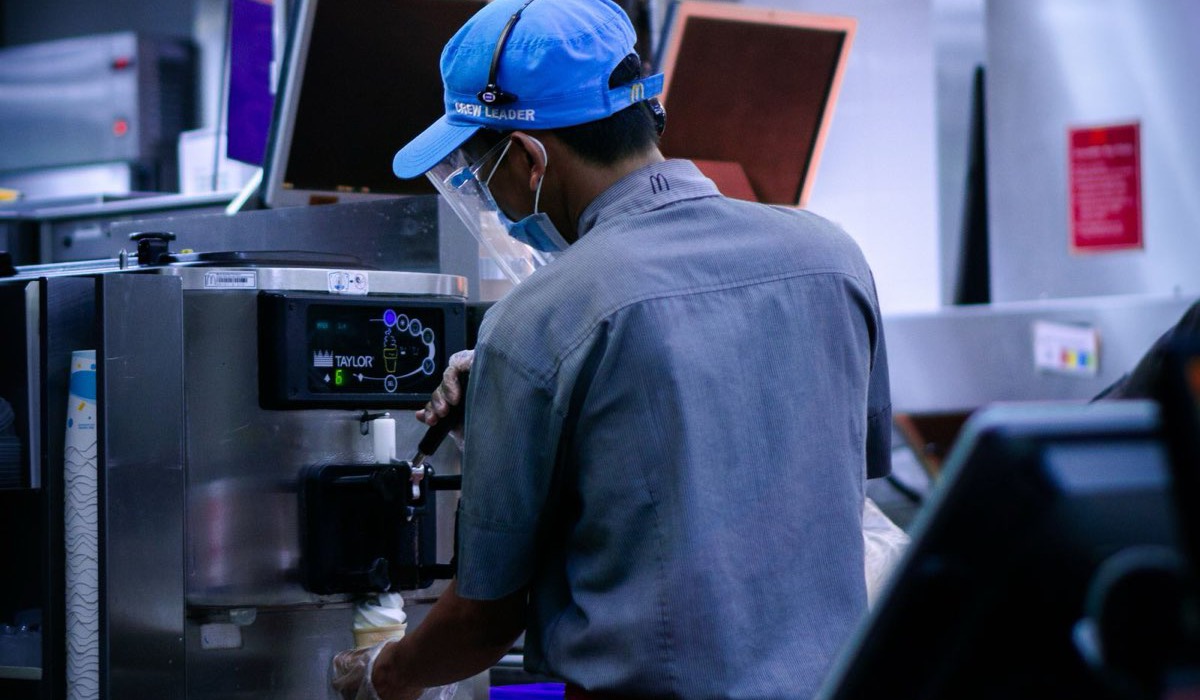
A fast food crew member is the person who makes a quick-service restaurant actually run. On any given shift a crew member might greet guests and ring up orders at the front counter, take orders on a headset and cash out cars at the drive-thru window, cook and assemble food to spec on the line, restock the station ahead of the lunch rush, and sanitise tables, floors, and restrooms between all of it. Most crew are cross-trained and rotate across those stations as the manager positions the team, so the same employee may work grill, fries, assembly, register, and drive-thru inside one shift. The core purpose never changes: get accurate orders to guests fast, keep the food safe, and make every guest want to come back, shift after shift, rush after rush.
That operational framing matters enormously for your resume. Hiring managers are not looking for someone who simply “worked fast food”; they are looking for someone who keeps service times low, order accuracy high, the store clean enough to pass a health inspection, and guests happy when a line is out the door. Crew members who spend most of their shift on the grill and assembly line do work that overlaps heavily with a line cook, while those anchored at the register share much of the day with a fast food cashier, and every one of those specifics is something you can prove on paper. Everything below is designed to help you do exactly that.
Fast food crew member duties and responsibilities
Responsibilities vary by brand, format (counter-service vs. drive-thru), and station, but almost every fast food crew member job description includes the core duties below, and understanding why each one matters helps you write stronger resume bullets.
| Duty | Why it matters to employers |
|---|---|
| Greeting guests and taking accurate orders on the POS (counter & drive-thru) | Order accuracy drives guest satisfaction and cuts the cost of remakes and refunds |
| Working the drive-thru headset and window under a timer | Speed-of-service times are tracked every shift, faster windows move more cars and more sales |
| Cooking and assembling food to brand spec on the line | Consistent builds protect the brand, reduce waste, and keep repeat guests coming back |
| Handling cash, cards, and the mobile/loyalty app at the register | Accurate cash handling protects revenue and keeps the queue moving at peak |
| Suggestive selling, combos, sizes, and add-ons | Directly grows average check size, a lever managers watch closely |
| Following food-safety and hygiene standards (handwashing, holding temps, FIFO) | Keeps guests safe and the store compliant when the health inspector arrives |
| Cleaning and sanitising stations, dining room, and restrooms | A clean store passes inspection and signals quality to every guest who walks in |
| Restocking and prepping the line before and during the rush | Keeps service uninterrupted so the team never stalls when volume spikes |
Skills employers look for
The strongest fast food resumes pair hard, teachable skills with the soft skills that hold a station together during a rush. Name the specific ones that appear in the job posting, that keyword match is what the ATS scores you on.
| Hard skills | Soft skills |
|---|---|
| POS / register & cash handling | Speed & composure under pressure |
| Drive-thru headset & order accuracy | Clear communication & teamwork |
| Grill, fryer & assembling food to spec | Friendly, guest-first hospitality |
| Food safety & hygiene (ServSafe / food-handler card) | Reliability & punctuality |
| Cleaning, sanitising & FIFO stock rotation | Adaptability, switching stations on demand |
“The fast-food resumes that win interviews don’t say ‘worked the counter’, they prove the crew member moved a number: drive-thru times, order accuracy, upsell rate, a spotless health score. One quantified line about staying fast and accurate under a rush beats a whole paragraph of duties.”
, ResumeCroc resume team
How much do fast food crew members earn?
Fast food crew roles are hourly, and pay varies with your state’s minimum wage, the brand, the shift you work, and how many stations you can cover. According to the U.S. Bureau of Labor Statistics, fast food and counter workers (SOC 35-3023) earn a median wage of about $14.20 an hour, with the middle of the field running from roughly $12.64 to $16.55, and the higher end typically going to reliable, cross-trained crew who have moved up to drive-thru lead, trainer, or shift lead. Many operators add perks on top: free or discounted meals, flexible scheduling, and shift-lead premiums.
Typical hourly pay progression (illustrative)
Relative pay grows with cross-training, reliability, and moving into lead roles, exact figures vary by employer, state minimum wage, and brand.
Directional, based on U.S. Bureau of Labor Statistics OEWS data (SOC 35-3023) and typical fast-food pay structures.
The takeaway for your resume: if you have covered every station, kept drive-thru times low, or been trusted with the cash drawer and opening or closing the store, put those specifics front and centre. They are the fastest way to justify a higher starting wage and stand out from a stack of near-identical applications.
How to put fast food experience on your resume (5 steps)
The biggest mistake applicants make is listing duties instead of achievements. Anyone can say they “took orders”, what gets interviews is measurable impact under pressure. Follow these five steps.
Mirror the job posting’s keywords
Pull the exact skills and tools from the listing (the POS name, “drive-thru”, “food safety”, “guest service”) and use them where they truthfully apply. This is what the ATS scores.
Do: “Operated POS and drive-thru headset while maintaining food-safety standards” · Not: “Worked the front”
Lead every bullet with a strong action verb
Start with verbs like served, prepared, maintained, trained, reduced, never “responsible for”.
Do: “Served 120+ guests per shift during peak lunch rush” · Not: “Responsible for customers”
Quantify the impact
Add a number to every achievement you can: drive-thru service time, order accuracy, transactions per hour, guest-satisfaction score, or upsell rate.
Example: “Maintained 98% order accuracy and a sub-3-minute drive-thru window while serving 120+ cars during dinner rush.”
Show progression and trust
Cross-training on every station, being trusted with the cash drawer, opening or closing the store, or training new hires signals reliability and leadership, exactly what managers promote.
Example: “Cross-trained on grill, drive-thru, and register; trained 4 new crew members and cut their ramp-up time by a week.”
Keep the format ATS-clean
Avoid tables, columns, text boxes, and graphics in the resume file itself, they confuse parsers. Use simple headings and bullets, then verify.
Check it free: ATS resume checker
How your resume actually moves through hiring
Understanding the journey explains why formatting and keywords matter so much. Your resume usually passes through four stages before you get a call:
Will your resume pass the ATS?
Paste your resume and a job description into our free checker for an instant ATS score, the keywords you are missing, and prioritised fixes, all in your browser, nothing uploaded.
Frequently asked questions
Do you need experience to become a fast food crew member?
No, most crew and team-member roles are genuinely entry-level, and employers hire for attitude, reliability, and the ability to stay calm during a rush. If this is your first job, emphasise transferable skills from school, sports, clubs, or volunteering: teamwork, showing up on time, communicating clearly, and handling money or customers. A short “Skills” section and a couple of examples of dependability go a long way when you have no formal work history yet.
What is the difference between a crew member and a cashier?
A cashier focuses mainly on the register, taking payments, making change, and processing the transaction, while a crew member rotates across the front counter, drive-thru, food-prep line, and cleaning, so the register is only one part of the shift. Many fast food roles combine both. If the job you want is mostly register-based, tailor your resume toward the money-handling and accuracy side, and see our guide to the responsibilities of a fast food cashier.
How do I make my fast food resume stand out?
Quantify your results, mirror the keywords in the job posting, show cross-training and progression, and keep the format clean so it parses correctly. Numbers like order accuracy, drive-thru times, transactions per hour, and guest-satisfaction scores are what separate a memorable resume from a generic one. If your experience leans more toward the kitchen than the counter, the same achievement-led approach transfers directly, the structure works whether you are applying as crew, cashier, or line cook.
Want an expert to do it for you?
Our writers rebuild your resume to beat ATS filters and impress the human reading it. Start with a free, no-obligation expert review of your current resume.

 By uploading my resume, I agree to the