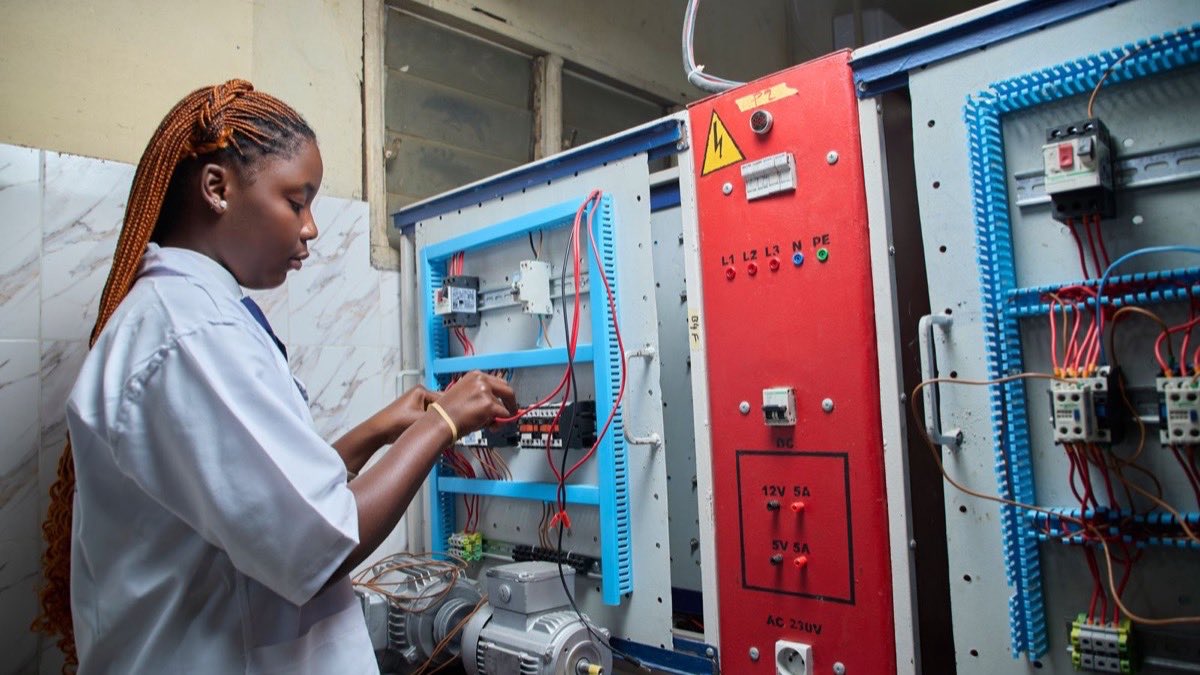
Key takeaways
- An electrician installs, maintains, and repairs the electrical systems that power homes, businesses, and factories, and the job runs on a licensing and apprenticeship pathway, not just hands-on wiring skill.
- Employers hire and pay for proven code knowledge (the National Electrical Code), a clean safety record, and the specific systems you have worked on: residential service panels, commercial lighting circuits, or industrial motor controls.
- The strongest electrician resumes lead with license level and apprenticeship hours, then back them up with measurable results (jobs completed on schedule, callback rate, years incident-free), not a list of tools.
- Run your resume through our free ATS resume checker before you apply.
Electrician job postings run the gamut from a residential service company hiring a helper to a manufacturing plant recruiting a licensed journeyman for industrial controls, and each version of the role asks for a slightly different mix of code knowledge, hands-on skill, and safety discipline. Whether you are an employer drafting the job description or an electrician trying to turn field experience into interviews, this guide breaks down exactly what electricians do, the duties and responsibilities employers expect, the license path that gates the trade, what the role pays, and how to present all of it on a resume that clears the applicant tracking system (ATS).
Unlike many hourly trades, electrician hiring is licensing-driven: an employer cannot legally assign certain work to an unlicensed worker, and a resume that buries license status inside a paragraph instead of the header is losing interviews before a human even reads the job history. We will fix that below, along with everything else that separates a resume that gets a callback from one that does not. If you are weighing a switch into the trade from another field, our resume writing services can also help you reframe prior experience for a career change.
What does an electrician do?
An electrician installs, maintains, troubleshoots, and repairs the wiring, panels, lighting, and control systems that deliver electricity safely to a building or piece of equipment. The work splits into three broad settings that employers care about, because each one calls for a different mix of skills: residential (homes and service calls: panel upgrades, outlet and fixture installs, troubleshooting), commercial (offices, retail, schools, and other larger buildings: bigger circuits, code inspections, tenant build-outs), and industrial (plants and facilities: motor controls, conduit runs, programmable logic controllers, and equipment that cannot go down without costing real money). Most electricians specialize in one setting, and naming yours clearly on a resume is one of the fastest ways to match a job posting.
The core purpose of the role is not simply “wiring things,” it is keeping people and property safe while keeping the lights, equipment, and systems running. Every task, from pulling a permit to running conduit, exists to satisfy the National Electrical Code (NEC) and pass inspection. That is why employers screen so heavily on license status and code knowledge: a mistake on this job is not just a rework cost, it can be a fire, a shock, or a failed inspection that stalls an entire project. Your resume needs to prove you understand that, not just that you know how to use a wire stripper.
Electrician duties and responsibilities
Responsibilities vary by setting and license level, but almost every electrician job description includes the core duties below, and understanding why each one matters to an employer helps you write stronger resume bullets.
| Duty | Why it matters to employers |
|---|---|
| Reading blueprints and electrical schematics | Prevents costly rework and keeps installs code-compliant from the first pull |
| Installing wiring, panels, breakers, and fixtures | The core billable work, done right the first time protects both schedule and margin |
| Applying the National Electrical Code (NEC) and local codes | Failed inspections delay jobs and expose the employer to liability |
| Following lockout-tagout (LOTO) and de-energizing procedures | Protects the crew from shock and arc-flash incidents, and keeps the jobsite insurable |
| Troubleshooting and repairing faults, outages, and equipment | Minimizes downtime, especially in commercial and industrial settings where every hour off the line is expensive |
| Coordinating with inspectors, contractors, and other trades | Keeps multi-trade jobs on schedule and avoids conflicts that stall a project |
Skills employers look for
The strongest electrician resumes pair hard, licensed skill with the soft skills that keep a jobsite safe and a client happy. Name the specific ones that appear in the job posting, that keyword match is what the ATS scores you on.
| Hard skills | Soft skills |
|---|---|
| NEC code knowledge & blueprint reading | Communication with clients & other trades |
| Conduit bending, wiring & panel work | Attention to detail under time pressure |
| Testing tools (multimeter, megohmmeter) | Troubleshooting instinct & calm problem-solving |
| Lockout-tagout & jobsite safety protocol | Reliability on scheduled service calls |
| State licensing (journeyman or master) | Physical stamina & comfort in tight or high spaces |
“Electrician resumes get rejected for the opposite reason most trades resumes do: too much task list, not enough proof. License level, apprenticeship hours, and the systems you have actually worked on, panel upgrades, industrial controls, service calls, win more interviews than a paragraph of duties ever will.”
ResumeCroc resume team
How much do electricians earn?
The median annual wage for electricians in the United States is $62,350 (about $29.98 an hour), according to the U.S. Bureau of Labor Statistics. Pay climbs with license level, specialization, and setting: a licensed journeyman running industrial controls or commercial tenant build-outs typically earns more than an apprentice on residential service calls, and master electricians who estimate, supervise, or run their own crew earn more still. Union membership, overtime availability, and local demand also move the number, sometimes significantly.
Typical pay progression by license level (illustrative)
Relative pay grows with license level and specialization, exact figures vary by state, union status, and employer.
Directional, based on U.S. Bureau of Labor Statistics occupation data (SOC 47-2111) and typical trade licensing tiers.
The takeaway for your resume: lead with your license level (apprentice, journeyman, or master) and your specialization. Those two facts alone tell an employer what you are qualified to do unsupervised and roughly what to pay you, before they read a single bullet point.
How to put electrician experience on your resume (5 steps)
The biggest mistake electrician applicants make is writing a materials-and-tools list instead of a track record. Anyone can say they “installed wiring.” What gets interviews is proof of license, code discipline, and results. Follow these five steps.
Put your license status at the top
State your license level (apprentice, journeyman, master), your state, and your license number if your state issues one, right in your header or summary. This is the first thing a hiring manager checks.
Do: “Licensed Journeyman Electrician, State of Texas #123456” · Not: “Experienced electrician”
Mirror the job posting’s keywords
Pull the exact terms from the listing (NEC, panel upgrades, PLC, conduit bending, low-voltage) and use them where they truthfully apply to your experience. This is what the ATS scores.
Do: “Performed 200A panel upgrades and NEC-compliant rewiring” · Not: “Fixed electrical stuff”
Lead every bullet with a strong action verb
Start with verbs like installed, diagnosed, upgraded, inspected, supervised, never “responsible for.”
Do: “Diagnosed and resolved intermittent circuit faults across 40+ commercial units” · Not: “Responsible for electrical repairs”
Quantify scope and safety record
Add a number wherever you can: jobs completed per week, panel amperage, square footage wired, callback rate, or years incident-free. Safety record is a genuine hiring factor in this trade.
Example: “Completed 300+ residential service calls with a sub-2% callback rate and zero safety incidents.”
Keep the format ATS-clean
Avoid tables, columns, text boxes, and graphics in the resume file itself, they confuse parsers. Use simple headings and bullets, then verify before you apply.
Check it free: ATS resume checker
How your resume moves through hiring
Understanding the journey explains why license details and keywords matter so much, even in a trade where word of mouth still counts. Your resume usually passes through four stages before you get a call:
Will your resume pass the ATS?
Paste your resume and the job posting into our free checker for an instant ATS score, the keywords you are missing, and prioritized fixes, all in your browser, nothing uploaded.
Frequently asked questions
Do you need a license to work as an electrician?
In most states, yes, for anything beyond supervised apprentice work. You typically start as a registered apprentice, then test for a journeyman license after completing the required on-the-job hours and classroom instruction, and can later pursue a master license with additional years of journeyman experience. Exact requirements vary by state and sometimes by city, so always confirm with your local licensing board.
How long does it take to become an electrician?
Most electricians complete a 4 to 5 year apprenticeship that combines roughly 2,000 hours of paid, on-the-job training per year with technical classroom instruction, often through a union program like the IBEW, an independent program like the IEC, or a trade school partnership. After finishing the apprenticeship, you sit for a journeyman licensing exam that covers the National Electrical Code.
What is the difference between a journeyman and a master electrician?
A journeyman electrician has completed an apprenticeship, passed a licensing exam, and can perform most electrical work independently under a license. A master electrician has put in additional years of journeyman experience, passed a further exam, and is typically qualified to pull permits, design systems, and supervise other electricians or run a contracting business.
Does residential, commercial, or industrial electrical work pay more?
Industrial and specialized commercial work (motor controls, PLCs, high-voltage systems) generally pays more than general residential service work, because it demands more advanced training and the cost of downtime is higher for the employer. Many electricians build their highest earning years by moving from residential into commercial or industrial specialization as they gain licensure and experience.
What is lockout-tagout, and why does it belong on my resume?
Lockout-tagout (LOTO) is the safety procedure for de-energizing equipment before service, so it cannot be switched back on while someone is working on it. Employers, especially in commercial and industrial settings, actively screen for candidates who can speak to safety protocol by name. Mentioning LOTO, arc-flash awareness, or a specific safety record signals you will not become a liability on their jobsite.
How do I make my electrician resume stand out?
Lead with your license level and state, quantify your results (jobs completed, callback rate, safety record), mirror the exact keywords in the job posting, and keep the file format simple so it parses cleanly. If you want a professional to build it for you, browse our full resume writing services for a done-for-you option.
Want an expert to build your resume for you?
Our writers turn your license, apprenticeship hours, and field experience into a resume that passes the ATS and gets you booked for interviews. Start with a free, no-obligation expert review of your current resume.

 By uploading my resume, I agree to the